
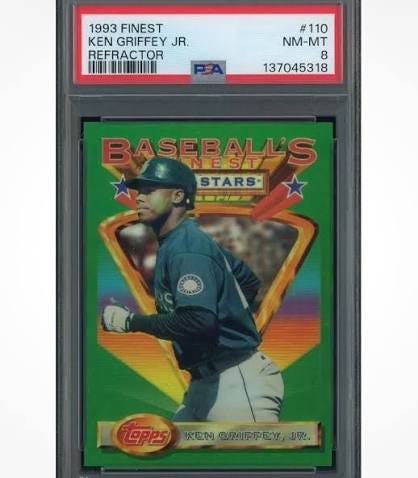
In the fall of 1993, Topps put a card on the market that didn’t say what it was. No stamp, no logo, no text on the back identifying it as anything other than a regular Finest card. Collectors had to hold it under a light and tilt it to see the rainbow. Andre Dawson figured it out fast enough to try to corner the market on his own card, paying up to three times Beckett value to buy back copies of his own refractor. That card is the reason your 2024 Bowman Chrome pack has a shiny parallel in it at all.
The Accident That Started It
1993 Topps Finest was Topps’ first swing at the super-premium market, a 199-card chromium set built to compete with Fleer Flair and Upper Deck SP. Hidden inside random packs, at a rate of roughly one per box, were cards coated in a special film that split light into color. Topps called them refractors. Nobody at the company seems to have anticipated what happened next.
The stated print run was 241 copies per card, based on 4,000 produced cases working out to that number across 199 subjects. That figure has never been officially confirmed by Topps, and it has never quite held up under scrutiny. PSA’s pop report alone shows 280 Frank Thomas refractors graded, 239 McGwires, 225 Sammy Sosas. Some of that is resubmission inflation. Some of it suggests the real print run was higher than legend says. Collectors have been arguing about this since the mid-1990s and nobody has settled it. That ambiguity is actually part of the card’s mythology, not a flaw in it.
What isn’t ambiguous is what happened to prices. By August 1996, the San Francisco Examiner reported the full 1993 Finest Refractor set selling for $25,000 to $33,000, the second-priciest Topps issue ever behind the 1952 set. The Nolan Ryan, the most contested card in the checklist, has had only 68 copies ever submitted to PSA, with just two graded a 10. Set registry collector Joe Kent has estimated those PSA 10 Ryans could fetch $12,000 to $15,000 each if they ever hit the open market. This was, by any reasonable definition, the first modern chase card.
How It Went From Cult Object to Hobby Standard
Refractors stayed a Finest exclusive for three years. Then in 1996, Topps extended the chromium technology to its flagship brand and created Topps Chrome, first in baseball, then football that same year, then basketball for the 1996-97 season. The basketball release is the one that changed everything, because it happened to be Kobe Bryant’s rookie year.
1996-97 Topps Chrome Basketball launched as a retail-only product that hobby shops didn’t particularly want. Boxes sat under $100 for years. Then the market caught up to what it was holding. Between October 2020 and January 2021 alone, three sealed boxes changed hands for $13,000 to $16,250 each. A refractor pulled 1-in-12 packs from a product nobody wanted in 1996 is now one of the single most valuable modern basketball releases in the hobby.
That’s the actual significance of the refractor as a technology. It took a decade to go from an unmarked mystery insert to the default parallel structure of the entire hobby. Every colored parallel tier you see today, from Prizm silver to Chrome gold to whatever numbered rainbow a manufacturer dreams up next, is a direct descendant of a card Topps didn’t even bother to label.
If you want the full breakdown on how we’re valuing early refractors inside the actual portfolio, that’s what The Cardboard Ledger is for. Subscribe and you get it biweekly, thesis and all.
Two Undervalued Plays From the Origin Set
The Jordans and Ryans of 1993 Finest are correctly priced. A PSA 9 Jordan refractor sold for $3,700 in October 2025 and $4,050 the month before that. The market has done its job there. The inefficiency sits one tier down, with Hall of Famers who don’t carry superstar premiums.
Kirby Puckett, 1993 Finest Refractor #112. PSA 9 copies sold for $725 in September 2024 and $552 in November 2024. Card Ladder’s current guide price sits at $1,174. This is a Hall of Fame batting champion, a franchise icon in Minnesota, on the card that started the entire refractor category, still trading under four figures in top grade.
Randy Johnson, 1993 Finest Refractor #154. PSA’s own auction data shows just 23 total recorded sales for this card, totaling under $13,000 combined, an average sale price barely over $500. A five-time Cy Young winner and a 300-game winner, on the same print run as the Ryan that’s estimated at five figures in top grade, trading at a fraction of the price.
Neither card is liquid. You are not flipping a 1993 Finest Puckett refractor in a week. But both sit on a checklist with a documented, decades-long track record of holding value through multiple hobby cycles, priced well below what their Cooperstown plaques and their scarcity would suggest.
The Takeaway
Refractors didn’t succeed because Topps engineered a hit. They succeeded because collectors turned an unlabeled anomaly into a category, and the technology proved durable enough to become the entire modern parallel structure. Thirty-plus years later, the cards that started it are still sitting there, HOF-caliber and scarce, priced like they’re a footnote to Jordan and Ryan instead of the reason those cards exist in the first place. That gap doesn’t close on its own. It closes when enough people notice the checklist has more than two names on it.